International Hiring
Virtual Assistant Costs: A Guide for UK Small Firms
Estimate UK VA budgets: £25–£35/hr for admin, compare retainers, overseas rates, VAT and setup costs.
8 min read

For a UK virtual assistant, I’d budget £25–£35 an hour for admin or £40–£60+ for specialist work. At 20 admin hours a month, that’s £500–£700 before fees and any VAT.
I’d compare quotes using the same tasks, hours and level of supervision - not just the hourly rate:
- Location: South Africa-based support typically costs £9–£18 an hour, with one to two hours’ difference from UK time.
- Payment model: Use hourly billing for occasional tasks, a retainer for regular work, or dedicated support for a full-time workload. Retainers may cut hourly costs by 10–20%, if you use the hours.
- Total cost: Add recruitment, software, setup and payment charges. Check whether 20% VAT applies or overseas VAT rules affect your bill.
- Hiring route: Hired Beyond charges £69.99 plus VAT monthly for Plus, or £600 for recruiter-led recruitment. Assistant pay is separate; check VAT on the £600 fee.
My starting point? Track tasks for two weeks, then get an <u>itemised written quote</u>. Agree who manages the work, check worker status and absence cover, and set a spending cap before you commit.
Virtual assistant rates by contract, location and role
Compare contract type, location and task complexity using these benchmarks before setting your budget.
Hourly rates, retainers and full-time fees
Retainers can lower the effective hourly rate by 10–20%, but only if you use most of the hours.
Hourly billing works well when workloads vary. Retainers reserve monthly hours, while full-time contractor fees cover a fixed commitment.
| Arrangement | Indicative spend and hours | Suitable tasks | Flexibility and unused hours | Your management duties |
|---|---|---|---|---|
| Hourly administration | £25–£35 per hour | Ad-hoc inbox, diary and data-entry work | Hours can vary; pay only for work done | Set priorities and approve work |
| Light retainer | £300–£400 for 10 hours per month | Small, recurring admin workload | Fixed allocation of hours | Maintain a regular task queue |
| Standard retainer | £550–£700 for 20 hours per month | Regular administrative support | Fixed monthly hours | Agree routines and review delivery |
| Specialist hourly support | £40–£60+ per hour | Bookkeeping, marketing or technical work | Scope and availability affect flexibility | Define outcomes and monitor delivery |
| Full-time contractor | £4,000–£5,600 for 160 hours per month | Defined, regular workflows | Fixed monthly commitment | Onboard, set clear workflows and review progress |
UK and South Africa rate comparisons
Location affects remote support costs. South Africa is typically one to two hours ahead of the UK, making it easier to share working hours.
| Role and responsibilities | UK indicative hourly budget | South Africa indicative hourly budget | Experience and supervision to compare |
|---|---|---|---|
| Administration: scheduling, inbox triage, data entry | £25–£35 | £9–£18 | Relevant experience, accuracy and ability to follow documented processes |
| Executive assistant: screening calls and diary control, board prep | Higher than basic administration | Rises with seniority | Strong judgement and ability to anticipate needs |
| Specialist: bookkeeping, marketing automation, technical work | £40–£60+ | Rises with specialist scope | Software expertise, independent delivery and review requirements |
South Africa-based rates usually range from £9–£18 per hour, increasing with seniority and specialist scope.
Compare the same brief, hours and supervision needs, not just the hourly price. Knowledge of UK processes can matter for client-facing and admin work. Weigh task scope, supervision and overlap with UK working hours alongside location.
How skills and task complexity affect rates
Rules-based inbox sorting and scheduling usually cost less than work that calls for more judgement. That includes executive assistance, bookkeeping in Xero or QuickBooks, and marketing automation.
A higher hourly rate can mean a lower total cost if it reduces supervision and rework. Use these rate bands to calculate your monthly spend in the next section.
sbb-itb-f12512f
Calculate your total monthly cost
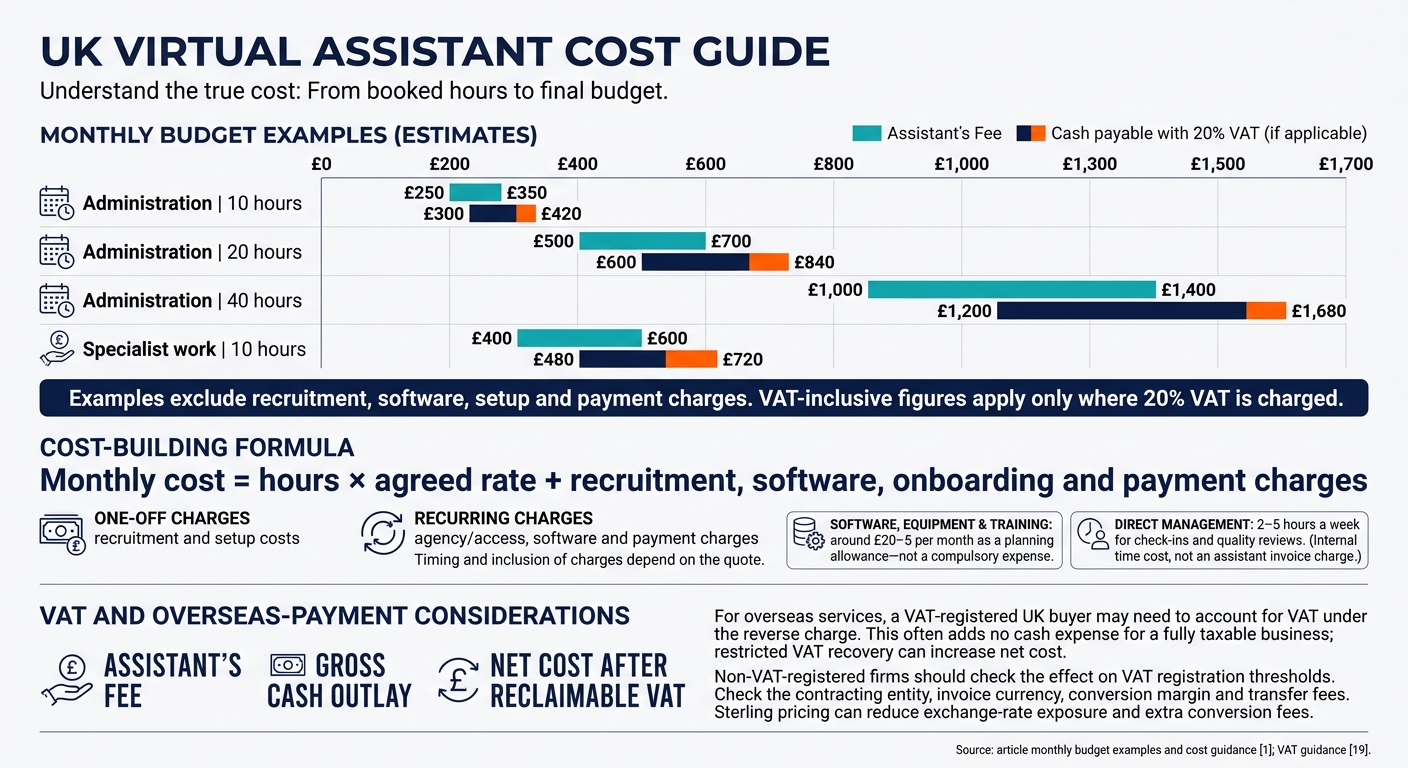
UK Virtual Assistant Costs: Monthly Budget Breakdown
Monthly cost = hours × agreed rate + recruitment, software, onboarding and payment charges. Keep three figures separate: the assistant’s fee, your gross cash outlay and your net cost after reclaimable VAT. Use them to compare hourly, retainer and dedicated-support options against your workload.
Example budgets for admin and specialist work
Based on the rate bands above, these examples show how your monthly spend changes with the hours booked. They exclude recruitment, software, setup and payment charges.
Support Monthly hours Hourly rate Assistant’s fee Cash payable with 20% VAT Administration 10 £25–£35 £250–£350 £300–£420 Administration 20 £25–£35 £500–£700 £600–£840 Administration 40 £25–£35 £1,000–£1,400 £1,200–£1,680 Specialist work 10 £40–£60 £400–£600 £480–£720
Recruitment fees, software and setup costs
Keep one-off recruitment and setup fees separate from recurring agency or access fees and assistant pay. Compare what each retainer includes, not just the headline total. Does the quote cover recruitment, management and backup cover?
Allow for software licences, equipment and any training needed. Around £20–£150 per month is a useful planning allowance, not a compulsory expense.
Your time has a cost, too. Direct management can take 2–5 hours a week for check-ins and quality reviews.
VAT and payment costs for overseas assistants
For overseas services, including support from South Africa, a VAT-registered UK buyer may need to account for VAT under the reverse charge. This often adds no cash expense for a fully taxable business, but restrictions on VAT recovery can increase the net cost.
Non-VAT-registered firms should check the effect on VAT registration thresholds. Also check the contracting entity, invoice currency, conversion margin and transfer fees. Sterling pricing can reduce your exposure to exchange-rate swings and extra conversion fees. Include these charges in your monthly total before choosing a payment model.
Choose a payment model for your workload
Match your hours to hourly, retainer or dedicated support
Start with a two-week task audit. Separate routine tasks, such as inbox triage and scheduling, from specialist work, such as bookkeeping or web development. Record recurring hours, the decisions the assistant will own and any required overlap with UK working hours.
Use this audit to choose the simplest payment model that fits your hours, supervision needs and monthly budget.
| Workload | Payment model | Cost predictability | Flexibility | Oversight |
|---|---|---|---|---|
| Occasional tasks or a trial | Hourly | Variable; agree a spending cap | High | Assign and check each task |
| Regular weekly work | Monthly retainer | High within agreed hours | Depends on rollover and extra-hours terms | Review priorities and hours used |
| Regular full-time or near-full-time work | Dedicated support | High for agreed capacity | Less freedom to change your commitment | Set priorities, give feedback and review performance regularly |
Check whether unused retainer hours expire, extra hours cost more and absences are covered. Dedicated support reserves capacity only. When comparing costs, include onboarding, supervision and payment administration.
Put the scope, hours, UK-hours availability, fees, extra-hours charges and worker-status terms in writing. Set out which decisions need approval. If the role looks like employment, budget separately for employer taxes, pension contributions and other obligations. Calling someone a contractor does not determine their status.
Hiring costs through Hired Beyond
If you plan to hire directly, add recruitment fees to your chosen payment model.
Hired Beyond is a recruitment marketplace for direct, longer-term hiring of identity-checked overseas specialists. Plus costs £69.99 plus VAT a month; recruiter-led recruitment costs a one-off £600. Specialist pay is separate. Confirm current pricing and whether VAT applies to the £600 fee before subscribing. Choose one route; do not add both fees together.
Hired Beyond takes no cut of specialist pay. You remain responsible for daily priorities and performance.
After hiring, you can cancel Plus and continue working with the specialist. For recruiter-led recruitment, check the refund conditions if no suitable candidate is found, along with the replacement guarantee if the hire leaves within 30 days. A replacement guarantee does not provide day-to-day absence cover.
Conclusion: set and review your VA budget
Once you understand the rate bands and extras, estimate costs based on the role, location and monthly hours, using the agreed rate. Use £25–£35 an hour as a UK admin benchmark, and compare South African quotes on a like-for-like basis.
Ask for an itemised written quote covering pay, fees, VAT and transfer charges. Keep one-off costs separate from monthly spending, and agree a monthly spending cap for the first three months. Any extra work should need your approval before it is billed.
Use the quote as your baseline. After the first month, weigh up billed hours, errors and time saved against the total cost. Then use those findings to adjust the budget, scope or payment model.
FAQs
How do I know if a virtual assistant is worth the cost?
A virtual assistant is worth the cost when their hourly rate is lower than the value of the time they free up for revenue-generating work. But don’t judge the expense on their rate alone. Include the time you’ll spend onboarding and managing them.
Before hiring, check whether your workload is steady, your tasks can follow a set process, and you have time to manage someone. If delegating inbox management, data entry and scheduling frees you up for paid work, that’s a good sign the cost could be worthwhile.
When does a retainer become cheaper than hourly billing?
A monthly retainer typically offers savings of 10% to 20% compared with hourly rates when you need regular support. Hourly billing is a better fit for trial periods, occasional help or workloads that vary.
Agreeing to a set number of hours each month makes budgeting more predictable. It also gives the assistant more stability, which can help them stay with you longer and improve the quality of their work.
How does overseas VA spending affect my VAT registration threshold?
Paying an overseas virtual assistant does not, by itself, count towards your UK VAT taxable turnover. That figure is based on your taxable sales to customers.
However, services bought from overseas may fall under the reverse charge. This means you may need to account for VAT as though you supplied those services yourself.
Check whether you must include these services when calculating your turnover for VAT registration, and speak to a qualified accountant about your obligations.