International Hiring
Hiring Overseas Staff: A Checklist for UK Employers
Practical checklist for UK employers hiring overseas staff: roles, status, visas, payroll, tax, data protection and onboarding checks.
8 min read

Hiring overseas? I’d start with where the person will work - not their nationality. Working abroad and relocating to the UK involve different employment, tax and immigration checks.
I’d split the checks into 3 stages:
- Before advertising: confirm the role, work country, hours and any limits on overseas data access.
- Before making an offer: check employee or contractor status, choose a lawful hiring route, and review local rights, pay, tax, social security and any sponsorship needs.
- Before day one: put terms in writing, verify work permission, arrange payroll, and prepare data safeguards, equipment and system access.
My rule: <u>don’t approve a start until the required work permission is confirmed</u>. For UK payroll, register for PAYE before the first payday. Give every unfinished check a named owner and deadline.
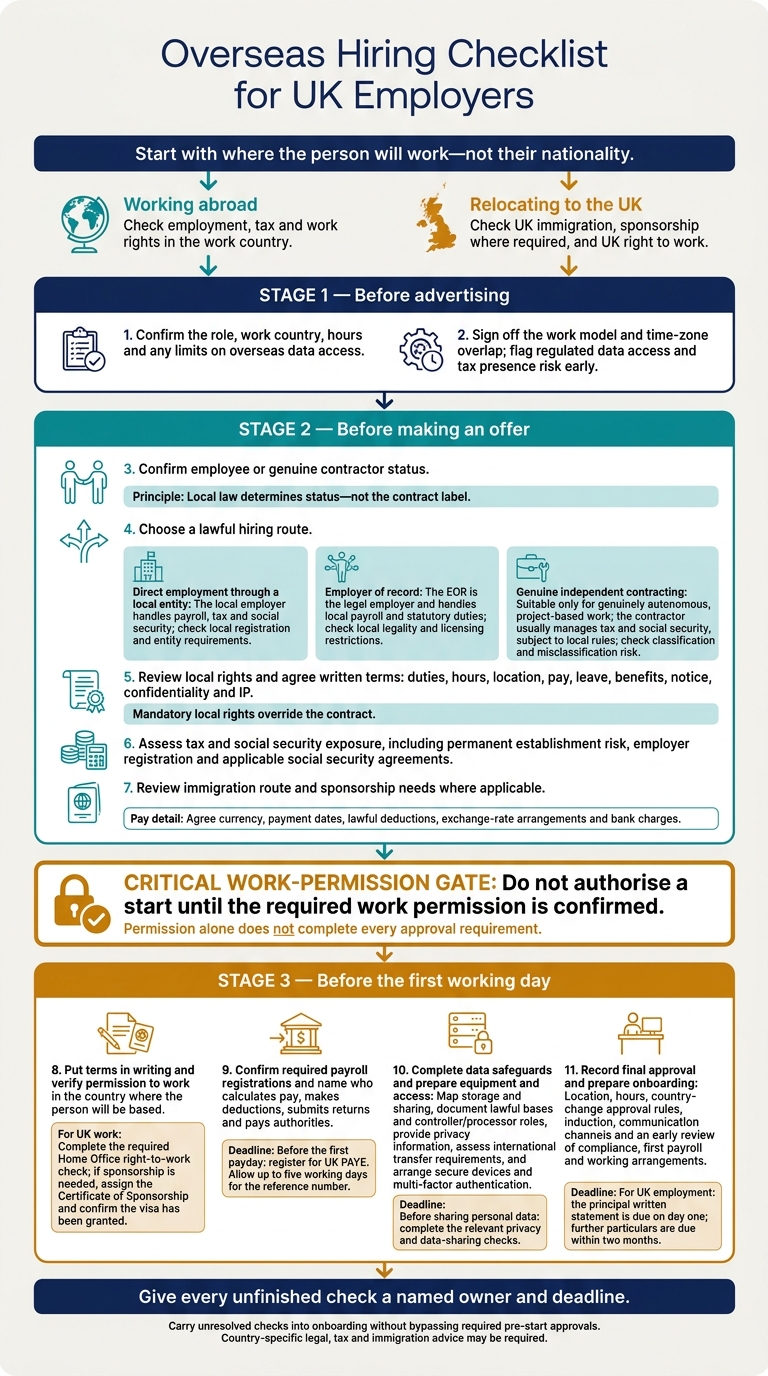
Overseas Hiring Checklist for UK Employers
How to Hire International Employees in the UK: Visas Explained for Employers
sbb-itb-f12512f
2. Before offer: confirm status and hiring arrangements
Once the role and work location are fixed, confirm the person’s legal status and how you’ll hire them.
Assess status based on how the person will work
Local law determines status - not the contract label. Use the agreed role, hours and location to assess whether the person is an employee or a genuine contractor. Record who controls their hours and working methods, whether you must offer work and they must accept it, and whether they can genuinely send a substitute. Also check how they fit into the business, whether they use company equipment, their other clients and the financial risk they carry.
HMRC’s Check Employment Status for Tax (CEST) tool can help, but it is not legally definitive. Review long-term contractor arrangements whenever duties or working practices change - not just when the contract expires.
Choose a lawful hiring arrangement
Check whether the UK company has, or needs, a local entity to employ the person directly, or whether it needs an employer of record. Get country-specific advice before agreeing terms.
Once you’ve confirmed the person’s status, choose a hiring model that the country allows.
| Arrangement | When it may fit | Payroll and statutory duties | Advice needed before approval |
|---|---|---|---|
| Direct employment through a local entity | You have, or will set up, a local entity | The local employer handles payroll, tax and social security | Local registration and entity requirements |
| Employer of record | You’re hiring without your own local entity | The EOR is the legal employer and handles local payroll and statutory duties | Local legality and licensing restrictions |
| Genuine independent contracting | The work is genuinely autonomous and project-based | The contractor usually manages tax and social security, subject to local rules | Classification, tax treatment and misclassification risk |
Assign responsibility for payroll, benefits, leave, insurance and employment records. If another organisation is the legal employer, confirm these responsibilities in writing.
Check tax and social security exposure
Assess UK and local permanent establishment risk: could the person’s activities create a taxable business presence abroad? Flag any authority to bind the business or carry out core trading activity.
Record their duties and expected duration so advisers can assess employer registration and available treaty relief before the offer. Check whether a bilateral social security agreement applies. Don’t assume you can transfer responsibility for contributions to the employee by agreement.
3. Before offer: agree contracts, pay and legal entitlements
Once you’ve confirmed employment status and the hiring route, put the terms for that arrangement in writing.
Record duties, hours and work location
Issue written terms before day one. Include the job title, duties, manager, country of work, start date, probation period and equipment responsibilities. Set out working hours, the time zone, overlap hours and which meetings require live attendance rather than written updates. Require approval before the employee changes their country of work.
For overseas remote staff, focus on the country where they’ll work. For relocation, make the offer conditional on lawful permission to work in the destination country. For UK employment, the principal written statement is due on day one, with further particulars due within two months. Check which local rules override the agreed terms.
Check which local rights override contract terms
Mandatory local rights override the contract. Have a local adviser review the terms before you issue them.
| Area | What to agree in writing | Mandatory rules to check locally |
|---|---|---|
| Pay | Gross salary and bonuses | Minimum wage, statutory bonuses and required 13th-month pay |
| Working time | Hours, breaks and overtime | Maximum hours, rest periods and overtime pay |
| Leave | Holiday allowance and public-holiday calendar | Minimum annual leave, public holidays, sick and parental leave |
| Benefits and statutory contributions | Benefits and pensions | Compulsory benefits, pensions and social security |
| Ending employment | Notice and termination terms | Minimum notice, dismissal procedures and severance |
| Confidentiality and IP | Confidentiality duties and ownership of work | Local enforceability and required IP assignments |
If you use an intermediary, make sure the service agreement assigns IP to your UK business.
Agree currency, payment dates and costs
State whether you’ll pay in pounds sterling or local currency. Record gross pay, payment frequency, payment dates and lawful deductions. If currency conversion is needed, specify the exchange-rate source, conversion date and who bears exchange-rate changes and bank charges.
Check local payment deadlines. Budget separately for employer contributions, statutory benefits and administration costs.
4. Before start: complete work permission, payroll and data checks
Once you’ve agreed the terms, finish the checks needed to get your new hire ready for day one.
Verify work permission and UK right to work
Before the start date, confirm the person’s right to work in the country where they’ll be based. For remote staff in South Africa, check local work rights: UK immigration permission does not allow them to work there.
For recruits moving to the UK, use the Home Office identity-verification service or a share code to verify UK immigration status, where applicable. Then check whether the role fits the immigration route and whether you need a sponsor licence.
Complete the required Home Office right-to-work check before anyone starts working in the UK. If sponsorship is needed, assign the Certificate of Sponsorship and confirm that the visa has been granted.
Set up payroll and assign tax duties
Finalise payroll registrations and agree who’s responsible for tax and statutory payments.
Before the start date, complete the required registrations and confirm who will calculate pay, make deductions, submit returns and pay the authorities. If you use an employer of record, it handles registrations, tax withholdings, social security filings and statutory benefit payments.
For UK payroll, register for PAYE before the first payday. Allow up to five working days for the reference number.
Protect personal data and secure system access
Set up privacy and access controls so records and systems are ready before onboarding.
Before sharing personal data, map where records will be stored and shared, document the lawful bases, and define each organisation’s role as a controller or processor. Provide privacy information covering retention, rights, monitoring and sharing.
Check whether overseas access requires a UK GDPR international transfer mechanism. For South Africa, get advice on POPIA obligations too.
Before the start date, arrange secure devices and multi-factor authentication. Make sure access is granted at onboarding and removed immediately when the worker leaves. Use current ICO guidance and local advice.
5. Conclusion: approve the hire and prepare for day one
Use these final checks to approve the hire and move into onboarding.
Before advertising
Sign off the role, work country and work model, including hours or time-zone overlap. Flag regulated data access and tax presence risk early so you can get country-specific advice.
Before making an offer
Approve the hiring basis: status, hiring route, pay, local entitlements, tax and social security exposure, and immigration route. Confirm approval for the route chosen earlier: direct employment, employer of record or contracting. Give each unfinished check a named owner and deadline.
Before the first working day
Record final approval of contracts, work permission or UK right-to-work checks, as applicable, payroll registration, and data protection and system access controls. Do not authorise a start until the required work permission is confirmed. Complete payroll registration before the first payday.
Carry unresolved checks into onboarding, keeping a named owner and deadline for each.
Keep onboarding details in one place: location, hours, change-approval rules, induction and communication channels. Set an early review date to check compliance, the first payroll and working arrangements.
FAQs
Can I hire abroad without a local entity?
Yes, you can use an Employer of Record (EOR) without setting up a local legal entity. The EOR acts as the worker’s legal employer in that country, handling payroll, tax deductions, statutory benefits and compliance with employment law. You keep control over day-to-day work and business direction.
For small to medium-sized teams, an EOR is generally faster and more cost-effective than setting up a local entity. You can also engage independent contractors, but you must classify them correctly to avoid legal and tax penalties.
Could an overseas hire create a foreign tax liability?
Yes. Hiring an overseas worker can create a permanent establishment, leaving your company liable for local corporate taxes even if it has no local entity. This can happen if the employee regularly concludes contracts on your behalf or maintains a fixed place of business.
Failing to meet local payroll, tax withholding and social contribution requirements can also result in penalties, audits and back taxes.
What if my overseas employee wants to work in another country?
Treat the move as a new employment relationship, not just a change of location. Check local employment law, contract compliance, tax residency, social security, data protection and the employee’s right to work. Also assess permanent establishment risk: the move could create corporate tax obligations in the new country.
Before approving the move, speak to your legal adviser or global employment partner. You may need an Employer of Record (EOR) to keep employment and payroll compliant in the new country.