International Hiring
How to Hire Remote Staff Abroad for Your UK Business
Start with the job, not the country: set duties, UK-time overlap and budget, then pick a lawful hiring model, check costs and vet candidates.
7 min readUpdated

To hire remote staff abroad, I’d start with the job - not the country. Set the duties, UK-time overlap and full budget in GBP, then check which hiring arrangement meets local rules.
Here’s the checklist I’d use:
- Plan the work: define skills, working hours and results for the first 30 days. South Africa is one hour ahead of the UK during BST and two during GMT.
- Choose the arrangement: compare direct employment, contracting and an Employer of Record. Check worker status, payroll, tax, data-transfer rules and who carries each risk.
- Check the full cost: include pay, employer contributions, equipment, service fees and the currency-exchange margin.
- Assess candidates: use Hired Beyond to shortlist, then check work samples, references, a structured interview and a short paid task.
- Agree terms and onboard: sign before work starts, confirm payment and IP ownership, provide secure access and training, and review progress weekly during the first month.
My rule: <u>check the legal setup before making an offer</u>, then judge your hire by work delivered - not time spent online.
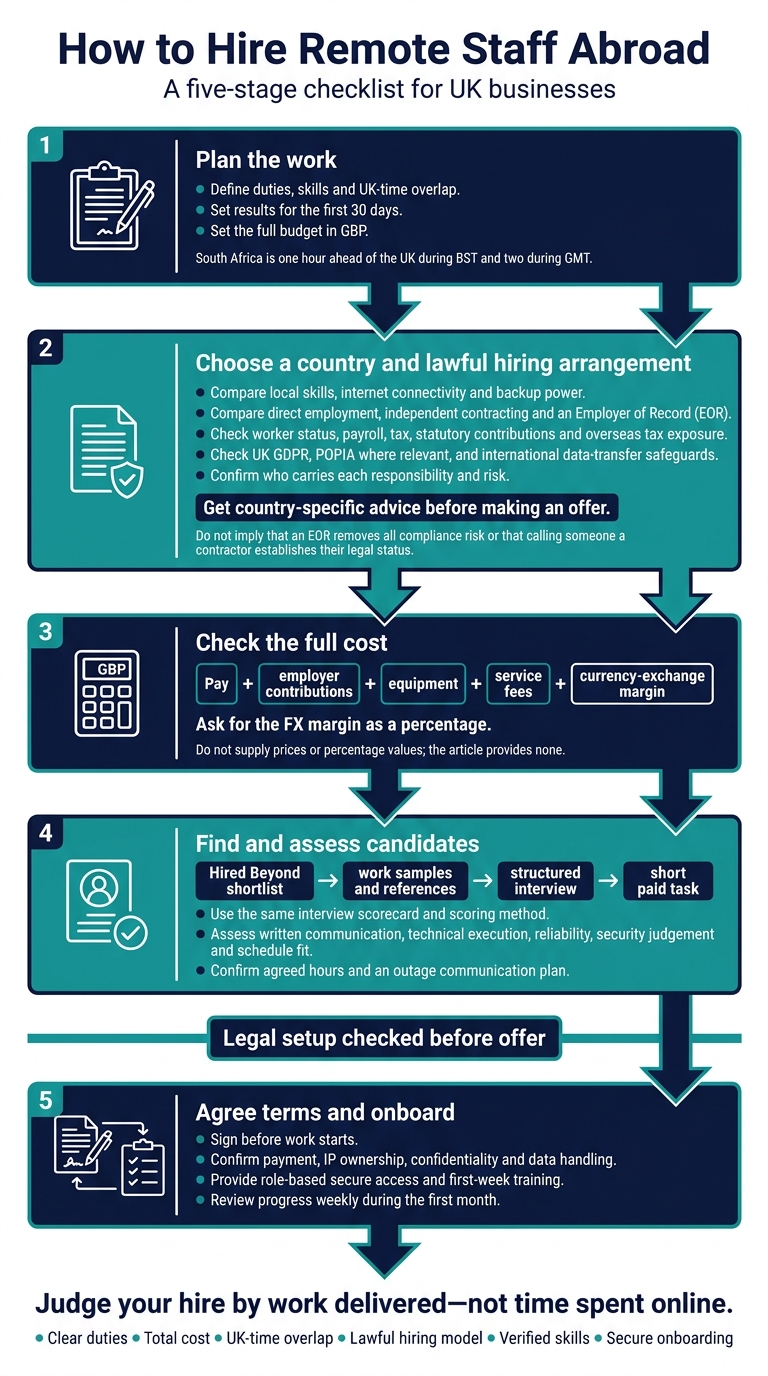
How to Hire Remote Staff Abroad: UK Business Checklist
2. Choose a Country and Hiring Arrangement
Once you’ve set the duties, hours and budget, choose a country and hiring model that can meet those needs legally and reliably.
Check Local Conditions and Legal Requirements
For overseas hires, practical conditions matter just as much as legal requirements. Compare local skills, internet connectivity and backup power. South Africa’s English-speaking business setting can suit UK teams, but check each candidate’s backup internet connection and power-cut plan before relying on them for UK-facing work.
Get country-specific advice before making an offer. In South Africa, review the Basic Conditions of Employment Act and Labour Relations Act, plus statutory registrations, tax and social security duties. Employment disputes can go to the Commission for Conciliation, Mediation and Arbitration (CCMA). Ask a tax adviser whether the role could create a permanent establishment, particularly if the worker negotiates contracts or manages operations.
Compare Employment and Contracting
Match the arrangement to the work - not just the fee. Will the person join your team, take on individual projects or work through an employing entity?
Employment status depends on the working relationship, including your control over the work, the worker’s financial risk, who provides equipment and how closely they fit into your business. Calling someone a contractor does not prevent backdated tax or benefit claims.
Use the local rules and the role’s needs to compare your options.
| Factor | Direct employment (local entity) | Independent contractor | Employer of Record (EOR) |
|---|---|---|---|
| Control | High (direct relationship) | Low (focused on results) | High (you manage the work; the EOR handles employment admin) |
| Administration | High (local payroll, tax and HR) | Minimal | Low (handled by EOR) |
| Cost predictability | Low (high setup costs and overheads) | High (fixed fees/invoices) | |
| Compliance exposure | High (company is liable) | High (misclassification risk) | Low (EOR assumes legal risk) |
| Best-fit use case | Large teams | Short-term/project work | SMEs and fast market entry |
Check Payroll, Tax and Data-Transfer Duties
Check which PAYE, tax and social security deductions apply in the UK and host country, then confirm who pays and remits them. If you use a South African employing entity, ask for its CIPC registration number. Agree who handles CCMA disputes and settlement costs, and put IP ownership in the contract.
Before sharing personal data, assess UK GDPR, South Africa’s Protection of Personal Information Act (POPIA) and any required international data-transfer safeguards. Cover both employee records and customer information the worker will access. Confirm who is responsible for secure access, storage and deletion.
sbb-itb-f12512f
3. Find and Assess Candidates
Search Hired Beyond by Role and Skills
Enter a plain-English role description, then filter by skills and rate. Narrow your search using the duties and hours you’ve already defined, and compare profiles side by side in the relevant category.
Treat ranked results as a starting point, not a final decision. Use direct messages and an introductory video call to check relevant experience and availability.
Check Experience and Work Samples
Review each candidate’s relevant work history, qualifications and anonymised work samples. Check their profile’s ID check and internal review, too. With their permission, contact references to confirm their responsibilities, accuracy and reliability.
Ask what the candidate personally delivered. A team’s results don’t tell you what one person contributed.
For a bookkeeper, check experience with your accounting software, bank reconciliations and payment approval controls. Ask how they investigate discrepancies and handle sensitive information.
Use Structured Interviews and a Paid Task
Ask every candidate the same core questions. Use one scorecard and the same scoring method to assess written communication, technical execution, reliability, security judgement and schedule fit.
Ask how they’ve handled unclear instructions, competing deadlines and mistakes. Assess business English through their explanations, not their accent or interview confidence. Check whether they document decisions and flag blockers early.
Set a short, fairly paid task using your team’s tools, fictional information and written instructions. Agree the fee, deadline and scoring criteria beforehand. Then assess both the result and how clearly the candidate explains their approach.
Before deciding, confirm that they can work the agreed hours and communicate quickly if an outage affects their work.
4. Agree Terms and Onboard Your Hire
Once you’ve chosen your candidate, agree the terms, arrange access and set clear expectations for their first week.
Put Contract and Payment Terms in Writing
Make sure the written terms reflect your chosen employment or contractor model and the actual working relationship. Sign the agreement before work starts. Cover duties, UK-time working hours, pay currency, confidentiality and data handling. Include notice, termination and dispute procedures that comply with the host country’s labour law. Specify who owns the work produced and when those rights transfer to your UK business.
Be clear about who handles payroll, tax deductions and statutory contributions. Ask for the FX margin as a percentage rather than accepting a vague promise about exchange rates.
Set Up Secure Access and First-Week Training
After the agreement is signed, provide only the access the role needs, using individual accounts, VPN, encryption and access controls. Document the rules for access, data handling, incident reporting and offboarding.
Build the first week around systems training, immediate priorities and clear measures of success. Keep instructions in shared documents and recorded walkthroughs so your hire can refer to them after calls. Agree where to ask questions, how soon to expect a reply and when to escalate a blocker. Name a person who will answer questions and check understanding.
Review Progress During the First Month
Use the first month to check whether your hire can deliver the role’s core outputs. Set goals before their start date, then hold weekly check-ins to discuss output, quality, workload and availability. Check that communication and overlap with UK working hours meet the role’s needs. Judge output, not online presence. If deadlines slip, check for gaps in training or unclear instructions, record the support provided and agree a revised goal.
5. Conclusion: Your Overseas Hiring Checklist
If the role, country and hiring model still fit after your checks, run through this checklist before making an offer.
Check six points: clear duties, total cost, UK-time overlap, a lawful hiring model, verified skills and secure onboarding. Include salary, employer costs, equipment and service fees in your budget.
Review compliance alongside the role brief. Ask qualified advisers to confirm worker status, local payroll duties, overseas tax exposure and cross-border data-transfer rules. If you use an Employer of Record, request its legal entity name and registration number.
Compare shortlisted candidates by responsibilities, skills, rates and experience. Verify their work samples, and use the same interview scorecard and a paid task for every shortlisted candidate.
Before committing, make sure the offer matches the local market and sets clear expectations. Check that documented workflows and regular feedback are in place. Can this hire meet the workload, time overlap and budget you set at the start?
FAQs
Can I hire overseas staff without a local entity?
Yes. An Employer of Record (EOR) acts as the legal employer and handles local payroll, tax registration, benefits and compliance with local labour law. This lets you hire full-time employees overseas without the admin or upfront costs of setting up a local legal entity.
You can also engage independent contractors, but correct classification matters. Too much control over how they work can lead to misclassification penalties.
What compliance risks remain when using an Employer of Record?
Your contract should clearly state who owns the intellectual property. Vague wording could leave those rights with the EOR rather than your business.
Confirm who acts as the controller or processor for HR and payroll data to meet the requirements of UK GDPR and the Data Protection Act 2018.
Also, spell out who represents the employer at disciplinary hearings or in legal disputes - and who pays the associated costs.
How do I set fair pay for a South African remote worker?
Research local market rates for the role rather than simply converting salaries between currencies. Factor in the candidate’s experience, local living costs and statutory requirements.
Make clear whether you’re hiring an employee or an independent contractor: each comes with different tax and benefit obligations. Explain whether pay follows a global band or local rates, and budget for statutory contributions, benefits, exchange rate changes and payroll administration.