International Hiring
Freelancer vs Employee: Remote Hiring for UK Firms
Choose freelancers for one‑off projects and employees for ongoing supervised work; compare total cost, control and legal duties for UK–South Africa remote hires.
9 min read

I’d choose a freelancer for a defined project and an employee for regular work that needs daily direction. Think a one-off automation build versus recurring diary and inbox support.
Before you hire, I’d check:
- Total cost: compare fees with salary, leave, equipment, payroll and replacement costs over the same period, in £.
- Flexibility and availability: agree deadlines or working hours, and plan for gaps.
- Control and continuity: decide how much supervision you need and how you’ll retain knowledge.
- Legal status: check the actual working relationship - not just the contract label.
- South African duties: confirm employment rights, tax, payroll, IP ownership and data safeguards before work starts.
For scheduling, South Africa is 2 hours ahead of GMT and 1 hour ahead of BST. For hiring, <u>location and working practices matter more than the job title</u>.
Quick Comparison
| Criterion | Freelancer | Employee |
|---|---|---|
| Best fit | Defined, independent project | Recurring, supervised role |
| Cost | Fees plus agreed changes | Salary plus employer costs |
| Flexibility | Hire for a set scope | Recruit for lasting capacity |
| Availability | May serve other clients | Agreed working hours |
| Control | Briefs and output reviews | Daily direction |
| Continuity | Agree documentation and handover | Retains knowledge within the team |
| Legal checks | Independence, tax and contract terms | Employment rights, payroll and termination |
| IP and data | Express terms and safeguards | Express terms and safeguards |
My rule: choose the working model first, check UK and South African duties, then shortlist candidates - including through Hired Beyond.
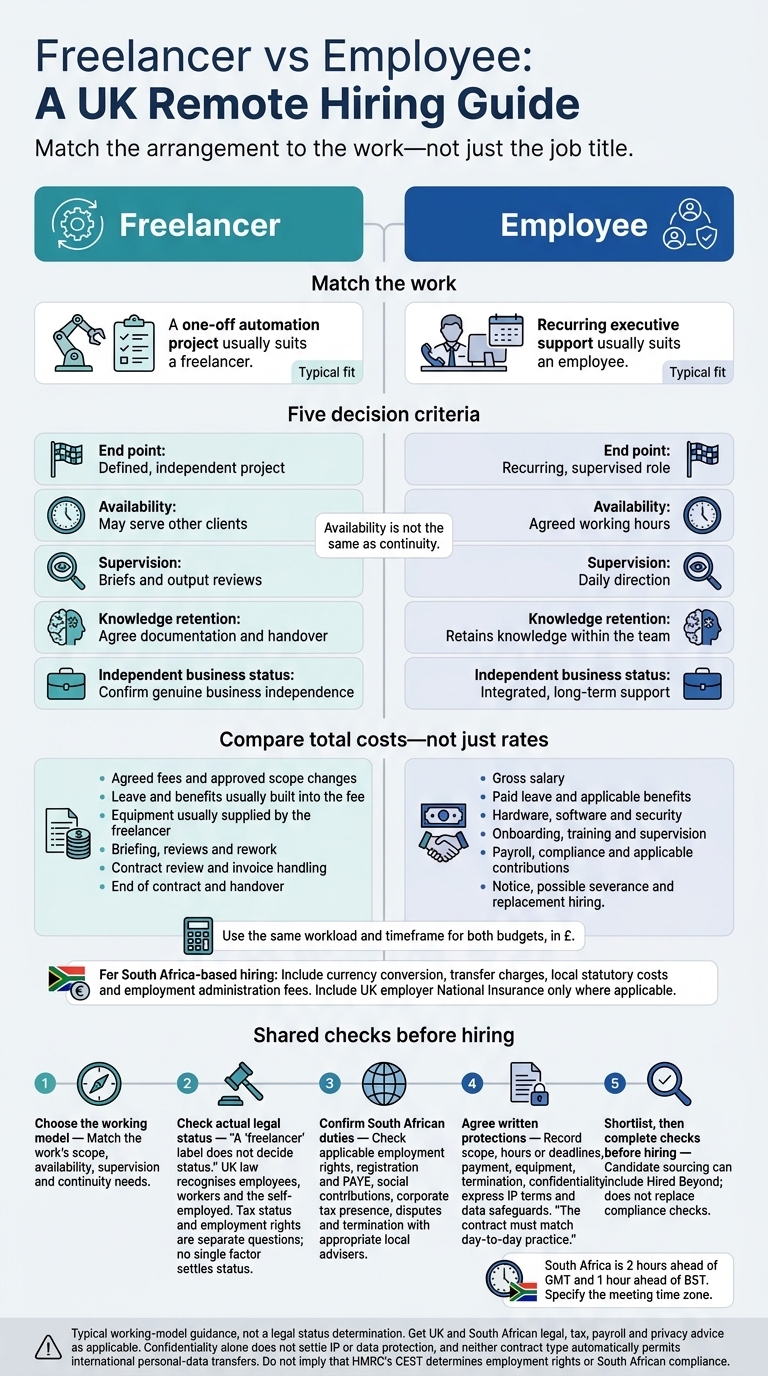
Freelancer vs Employee: A UK Remote Hiring Guide
3. Scope of employment: who is an employee, worker, or self-employed, what rights at work and taxes?
sbb-itb-f12512f
Freelancer vs Employee: Costs, Control and Continuity
Once you’ve chosen a work model, compare what each option means for cost, control and continuity.
| Factor | Freelancer | Employee |
|---|---|---|
| Cost structure | Fees for agreed work; scope changes can increase costs | Salary plus employer costs |
| Availability | May have commitments to other clients | Agreed working hours |
| Supervision | Briefs, milestones and sign-off checks | Direction over daily tasks and methods |
| Continuity | Future availability is not guaranteed | Builds knowledge of the organisation over time |
| Confidentiality | Set out confidentiality and IP ownership in the contract | Cover confidentiality and IP in employment terms |
| Scalability | Add specialist capacity for short periods | Recruit and onboard for lasting capacity |
| Delivery risk | Missed deadlines, rework and reliance on one contractor | Day-to-day management demands and staff turnover |
Availability is not the same as continuity. If others will need to maintain the work, require written handover notes and documented processes.
Freelancers for Defined Projects
A one-off automation project usually suits a freelancer; recurring executive support usually suits an employee.
A freelancer runs an independent business. They invoice for agreed work, work independently and handle their own tools and taxes. This arrangement fits when the outcome, end point and scope for independent delivery are clear.
| Consideration | What it means in practice |
|---|---|
| Advantages | Access specialist skills without creating a permanent role |
| Disadvantages | Later changes or support may need a new agreement |
| Suitable workloads | Builds, testing or other work with a clear finish |
| Payment methods | Fixed project fee, milestone invoices or agreed hourly billing |
| Management input | Detailed briefs and output reviews, rather than daily direction |
For an automation brief, agree deliverables, acceptance tests, milestones, documentation, fees, defect fixes and paid scope changes before work starts.
Include a written IP assignment where needed. Paying an invoice alone should not be treated as securing ownership.
Employees for Regular, Supervised Work
Employment is usually a better fit when work is regular and closely managed.
An employee works under an employment contract, but the actual relationship - not its label - determines status.
Recurring diary management, inbox handling and meeting preparation need set availability, close supervision and clear priorities.
Budget for training, payroll, employment documents, statutory rights and leave under applicable law. Put documented processes and absence cover in place, too.
Compare Total Costs, Not Just Rates
Compare the full cost over the period you need the work done. Use actual quotes and salary proposals to build project and 12-month role budgets in pounds sterling (£).
For South Africa, include currency conversion, transfer charges, local statutory costs and employment administration fees. Include UK employer National Insurance only where applicable; don’t automatically add it to a South Africa-based role.
| Budget item | Freelancer: project total (£) | Employee: annual role total (£) |
|---|---|---|
| Pay | Agreed fees and approved scope changes | Gross salary |
| Leave and benefits | Usually built into the fee | Paid leave and applicable benefits |
| Equipment | Usually supplied by the freelancer | Hardware, software and security |
| Management | Briefing, reviews and rework | Onboarding, training and supervision |
| Admin | Contract review and invoice handling | Payroll, compliance and applicable contributions |
| Exit or replacement | End of contract and handover | Notice, possible severance and replacement hiring |
Use the same workload and timeframe for both budgets. Assess specialist project capacity against a defined outcome, and employment costs against recurring demand that justifies the commitment.
UK Employment Status and Contract Duties
Once control and continuity point towards a working model, check the legal status. A ‘freelancer’ label does not decide status. UK law looks at how the work is done in practice. Getting the classification wrong can lead to tax liabilities and employment-rights claims.
Assess How the Person Actually Works
UK law recognises employees, workers and the self-employed. Tax status and employment rights are separate questions, so use Acas employment status guidance alongside your tax assessment.
Look at control, personal service, genuine substitution, mutual obligation, hours, financial risk, equipment and integration. No single factor settles the question - not even a substitution clause or the use of company equipment.
Use these factors to write terms that match the role, rather than its label.
Write Clear Terms and Review Status
Put the scope, deliverables, autonomy, any genuine substitution right, payment, confidentiality, IP, data security and termination terms in writing. The contract must match day-to-day practice, not just promise independence on paper. Review status whenever duties, hours or supervision change, and annually too.
Once the contract reflects reality, check the tax position. Use HMRC’s Check Employment Status for Tax (CEST) tool with accurate facts. Do not treat its result as a ruling on employment rights or South African compliance.
Incorrect classification can lead to PAYE, National Insurance, interest and penalties, as well as holiday-pay or other rights claims. For South Africa-based workers, get separate advice on local status, payroll, tax and social security.
Hiring Remote Workers in South Africa
Once UK status is clear, check which South African rules apply to the working arrangement. Confirm the compliance route before signing: who will pay, where the work will take place, and whether you need local advice on employment, tax and payroll duties.
Check South African Employment, Payroll and Tax Rules
South Africa’s Basic Conditions of Employment Act (BCEA) and Labour Relations Act (LRA) apply where the work takes place there. A statutory presumption of employment can apply below the current earnings threshold. Check the latest figure rather than relying on an old template.
Use this checklist to separate legal duties from commercial preferences before work starts:
| Issue | Freelancer considerations | Employee considerations | Professional advice required |
|---|---|---|---|
| ☐ Employment rights | Confirm genuine business independence and whether the statutory presumption applies. | Check BCEA leave, hours and notice requirements, plus LRA protections. | South African employment lawyer |
| ☐ Registration and PAYE | Confirm the tax treatment and whether withholding applies. | Establish the employing entity’s registration, PAYE withholding and filing duties. | South African tax and payroll specialist |
| ☐ Social contributions | Check duties against the actual arrangement. | Assess UIF, Skills Development Levy (SDL) and occupational-injury compensation duties under COIDA. | Local payroll specialist |
| ☐ Corporate tax presence | Assess permanent-establishment risk, including authority to conclude contracts for the UK firm. | Assess permanent-establishment risk, particularly for senior roles with signing authority. | UK–South Africa corporate tax adviser |
| ☐ Disputes and termination | Agree commercial dispute and exit terms. | Check fair dismissal procedures and responsibility for CCMA proceedings. | South African employment lawyer |
These checks matter more than a headline payroll rate. SDL is generally 1% where annual payroll exceeds R500,000. UIF involves both employer and employee contributions, subject to a ceiling.
Once you’ve checked legal and payroll duties, put the working rules in writing.
Set Hours, Payment Terms and Data Safeguards
Record the agreed hours, equipment, payment dates, notice and dispute handling. South Africa is 2 hours ahead of GMT and 1 hour ahead of BST, so specify the time zone for meetings. Choose GBP or ZAR, agree who bears exchange-rate changes and transfer fees, and state any FX margin as a percentage.
Confidentiality alone does not settle IP or data protection. Include express IP terms and access controls before sharing files. Ask a privacy adviser to assess UK GDPR international-transfer requirements and South African POPIA duties where applicable. Neither an employment contract nor a services agreement gives automatic permission to transfer personal data.
Conclusion: Match the Arrangement to the Work
Compare cost, control and continuity, then match the model to the work: a freelancer for independent delivery, an employee for integrated, long-term support. Weigh total cost, management time and legal responsibility against the control the role needs.
Use 5 Criteria to Guide Your Choice
Check five things: the end point, availability, supervision, knowledge retention and independent business status.
If the answers point towards employment - for example, a ‘freelancer’ needs fixed hours, personal service and close supervision - get a legal and tax review.
Find Candidates Through Hired Beyond
Once you’ve chosen the model, find candidates to match. Use Hired Beyond to find and shortlist South African remote specialists, then complete local employment, payroll and tax checks before hiring.
FAQs
Can I hire a South African employee without a local entity?
No, not directly. You generally need a registered local company to hire an employee in South Africa. If you don’t have a South African entity, an Employer of Record (EOR) is a practical option. The EOR holds the local registrations and employs the person, while you manage their work.
How do I move a freelancer into employment?
Replace the project-based agreement with a formal employment contract that meets local labour laws. Check employment status carefully: regulators look at how the working relationship works in practice, not just the label on the contract.
The most practical route is an Employer of Record (EOR), which legally employs the worker without you having to set up a local entity. The EOR handles payroll, taxes, statutory benefits and local compliance. You keep day-to-day supervision and control over their work output.
Which country's law governs a remote working dispute?
No single law covers every cross-border remote working dispute. Each country has its own rules on worker classification, contracts and dispute resolution.
Your contract should state which law applies and how disputes will be handled, whether through mediation, arbitration or another method. It should also meet legal standards in both your country and the worker’s location. Authorities look at how the working relationship works in practice, not just the label in the contract.