International Hiring
7 Interview Questions for Hiring a Virtual Assistant
Seven evidence-based interview questions to test VA experience, judgment, UK-hour coverage, security and reliability, plus a scorecard.
11 min read

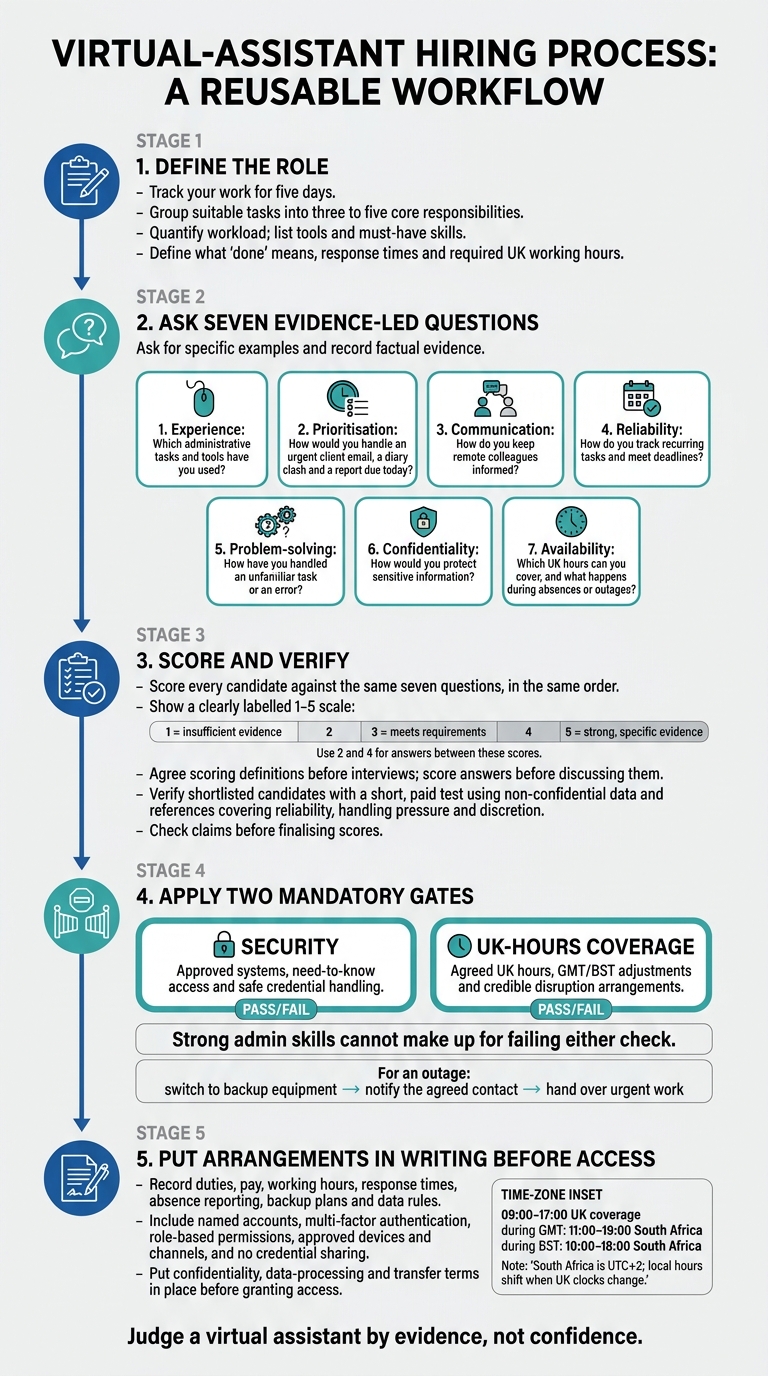
I’d hire a virtual assistant based on what they can show - not what they promise. Start with a clear task list, then use these seven questions to check whether they can do the work and cover your UK hours:
- Experience: Which administrative tasks and tools have you used?
- Prioritisation: How would you handle an urgent client email, a diary clash and a report due today?
- Communication: How do you keep remote colleagues informed?
- Reliability: How do you track recurring tasks and meet deadlines?
- Problem-solving: How have you handled an unfamiliar task or an error?
- Confidentiality: How would you protect sensitive information?
- Availability: Which UK hours can you cover, and what happens during absences or outages?
I’d ask for specific examples, compare answers on a 1–5 scale, and check shortlisted candidates through references and a short, paid test. Before sharing access, I’d put duties, pay, UK working hours, backup plans and data rules in writing - with <u>security and agreed hours as pass/fail checks</u>.
How to Hire a Virtual Assistant: Evidence-Based Checklist
Virtual Assistant Interview Questions and Answers for 2025
sbb-itb-f12512f
Define Your Support Needs Before the Interview
Track your work for five days before writing the brief. Look for repeat tasks that don’t need your expertise or a licence, then group them into three to five core responsibilities. Put numbers against the workload, such as monthly lead volume, posting frequency or active projects, so candidates know what they’ll need to handle.
List the tools they’ll use, whether that’s Microsoft 365, Google Workspace or your CRM. Separate must-have skills from processes you can teach. Strong written English, sound judgement and core software skills should be in place from day one. Your brand voice, reporting templates and internal workflows can be taught.
Set clear expectations for day-to-day work. Explain what ‘done’ means and agree response times for each priority level. Make the distinction between acknowledging a request and resolving it, and state whether those targets apply only during agreed working hours.
Specify the hours you need covered in the UK, allowing for GMT/BST changes. South Africa is UTC+2, so the assistant’s local hours must shift when UK clocks change to maintain the same UK coverage.
Set confidentiality rules before granting access. These should include an NDA, a password manager for shared logins and role-based permissions. State which sensitive records the assistant needs to access and which are off limits.
Build every interview question around these requirements, paying particular attention to coverage of the agreed hours and how candidates would respond to disruption. The questions below test their experience, judgement and reliability against your brief.
1. Which administrative tasks and tools have you used?
What the answer reveals
This question checks whether the candidate can do the admin you need - not just claim experience. Ask how many people they supported at once, how many emails they triaged each day and how many meetings they coordinated each week. Focus on what they personally handled, rather than the team’s workload.
Positive answer signals
Look for clear ownership of tasks in your brief, such as diary management, inbox triage and drafting replies in a leader’s voice. Ask which Microsoft 365 or Google Workspace features they used for those tasks. Check how they kept CRM records accurate. For document work, ask whether they wrote documents from scratch or only formatted existing material.
Red flags
Watch for vague answers, unsupported claims such as “I handled all the admin”, and lists of tools with no explanation of how they used them.
Follow-up assessment
Set a short exercise using fictional data in the software they’ll use. Ask the candidate to categorise 10 emails and draft one reply, or update a CRM record from an email thread. Agree the time limit and marking criteria before the test. Assess accuracy, clarity and judgement, and don’t use live business work as an unpaid test.
2. How would you prioritise an urgent client email, a diary clash and a report due today?
Use a scenario that reflects the work they’ll actually handle.
What the answer reveals
This tests judgement under pressure: can the assistant keep deadlines on track without constant supervision? A strong candidate checks deadlines, impact and gaps in information before choosing what comes first. Notice whether they ask what makes the client email urgent and who the diary clash affects.
Positive answer signals
Look for clear reasoning about what can wait and the consequences of delaying it. The candidate should explain what they can resolve independently, what needs approval and how they would update affected colleagues or clients before deadlines slip.
Red flags
Be wary of “I always do emails first” or promises to do everything without checking the scope. A fixed order ignores the situation. No early warning, blaming others and treating missed deadlines as unavoidable are also warning signs.
Follow-up assessment
Ask how they would respond if all three were due at once. Look for a revised plan: what they would pause, who they would escalate to and when they would warn stakeholders. Assess their reasoning and willingness to flag a problem early - not whether they guess your preferred order.
3. How do you communicate clearly with different colleagues remotely?
After testing prioritisation, check whether the candidate can keep remote work moving through clear communication.
What the answer reveals
This question tests whether the candidate gives clear updates, checks instructions they don’t understand and adjusts their tone for senior leaders or external partners. It also shows whether they choose the right channel for remote updates and know when to escalate a decision instead of guessing.
Positive answer signals
Look for clear summaries, clarifying questions before work starts and written updates that keep work moving without extra meetings.
Red flags
Watch for vague, indirect answers, weak written updates or a reliance on frequent calls when a written update would do. Treat slow or reluctant clarification of instructions as a concern.
Follow-up assessment
Ask: “Tell me about a misunderstanding with a remote colleague. How did you resolve it, and what did you change afterwards?” Listen for a specific example, clear ownership and a lasting process change, such as confirming instructions in writing. Assess ownership and whether the candidate changed their process.
4. How do you track recurring tasks and meet deadlines?
After checking communication skills, find out whether the candidate can keep routine work on track without reminders.
What the answer reveals
This question checks whether the candidate follows a repeatable system for recurring work rather than relying on memory alone.
Positive answer signals
Look for tools such as Asana, Google Calendar or a checklist to manage fixed cycles. Strong candidates prioritise accuracy, check work before closing it and flag at-risk deadlines early with a clear recovery plan.
Red flags
Be cautious if they only name a tool without explaining their routine. Reporting a delay only after the deadline has passed, blaming others or making no process change after a missed commitment suggests weak ownership.
Follow-up assessment
Ask: “Tell me about a commitment you missed. What did you do next, and what did you change to prevent it happening again?”
Ask exactly what they changed in their checklist, reminders or standard operating procedure. Then check whether that change worked in the next cycle. Record insufficient evidence if they cannot give a specific example.
5. How have you handled an unfamiliar task or an error?
What the answer reveals
This question tests judgement when the answer is unclear: does the candidate investigate before acting, and do they know when to seek approval?
Positive answer signals
Look for a clear sequence: gathering context, checking instructions, checking assumptions, weighing options and asking focused questions about what is still unclear. Strong answers explain how the candidate checked the result and recorded the reasoning so someone else could follow it.
Red flags
Be wary of guessing to save time or taking action outside policy. Quietly fixing an error without telling affected people is a concern; they need the information to manage the impact.
Follow-up assessment
“How did you investigate, where did you stop for approval, and how did you verify the result?”
Ask who they informed and what they shared.
If they handle mistakes well, the next check is whether they can protect confidential information.
6. How would you protect confidential information?
What the answer reveals
This checks whether confidentiality guides everyday habits - not just whether someone signs an NDA. Listen for neutral references to past employers and a strict need-to-know approach.
Positive answer signals
They should describe how they limit access, use approved systems and handle sensitive files only through authorised channels.
Red flags
Be wary of forwarding files, downloading records or storing work information in personal accounts without permission. Resistance to MFA, password sharing or revealing confidential details about past employers or clients suggests weak security habits.
Follow-up assessment
“How would you respond to a misdirected confidential email or a lost work device?”
Look for immediate reporting, compliance with incident procedures and steps to limit exposure. Waiting to see whether anything goes wrong isn't a safe response.
Once you've checked their approach to confidentiality, assess whether they can cover the UK hours you need.
7. Which UK working hours can you cover, and how would you handle absences or disruptions?
Coverage matters just as much as confidentiality.
What the answer reveals
Ask exactly which UK hours they can cover, accounting for breaks, meetings and handovers. Check how GMT/BST changes affect their local schedule and whether their power and internet connections can support those hours.
Positive answer signals
Look for clear agreement on response times during working hours and a fixed notice period for planned leave. Strong candidates can explain their backup internet, backup power and a handover document covering deadlines, contacts and unfinished work.
Red flags
Treat promises of constant availability cautiously. Vague working hours, no allowance for clock changes, or “I have a backup” without details leave coverage uncertain. Ask when they last tested that backup and whether they have a written escalation path for longer outages.
Follow-up assessment
Ask how the candidate would respond if an executive had an urgent client matter while their local area was experiencing a power outage.
Listen for three actions: switching to backup equipment, notifying the agreed contact and handing over urgent work.
Compare Candidates with an Interview Scorecard
After the interview, score every candidate against the same seven questions, in the same order. Score each answer before discussing it: 1 = insufficient evidence, 3 = meets requirements, 5 = strong, specific evidence. Use 2 and 4 for answers that fall between these scores. Agree what each score means for your role before interviews begin.
Give each candidate one row. Keep notes factual: record decisions, gaps identified and how conflicts were handled, rather than general impressions.
Use the scorecard to compare candidates side by side across the seven areas you tested.
| Candidate | Relevant experience | Prioritisation | Communication | Reliability | Problem-solving | Confidentiality | Availability | Evidence notes |
|---|---|---|---|---|---|---|---|---|
| First candidate | - /5 | - /5 | - /5 | - /5 | - /5 | - /5 | - /5 | |
| Second candidate | - /5 | - /5 | - /5 | - /5 | - /5 | - /5 | - /5 | |
| Third candidate | - /5 | - /5 | - /5 | - /5 | - /5 | - /5 | - /5 |
Check claims before finalising scores. Give shortlisted candidates one non-confidential exercise. Ask references about reliability, handling pressure and discretion - not project details. Never ask for previous clients’ confidential material.
If interviewers disagree, compare the evidence against your scoring rules before changing scores. Treat UK-hours coverage and security as pass/fail checks. Strong admin skills cannot make up for failing either check, and unsafe credential handling is not trainable.
Confirm Working Hours and Remote-Working Arrangements
Once you’ve agreed that the candidate is a good fit, put the practical terms in writing. To cover 09:00–17:00 UK time, record 11:00–19:00 in South Africa during GMT and 10:00–18:00 during BST. Agree how much notice is needed for leave, how to report sickness or other absences, and how UK bank holidays and South African public holidays affect availability.
Choose one main communication channel and a backup route for urgent contact. Set response times, name the person who receives absence reports and spell out which decisions need your approval.
Write down what happens if the power or internet goes down, including backup internet and power arrangements.
Set access rules before sharing any client data. Require named accounts, multi-factor authentication and only the access needed for the role. Allow only approved devices and channels, ban credential sharing and keep a record of access approvals.
Record who is responsible for personal data and put confidentiality terms in place. Document the data-processing and transfer terms before granting access.
Conclusion
Judge a virtual assistant by evidence, not confidence. Look for the experience, judgement and fit needed to support your workload.
For your final checks, use a short, paid skills test and ask previous managers how the candidate handles pressure and sensitive information. Before the start date, agree responsibilities, pay, working hours and response times in signed terms.
The right hire should save you time from day one and work reliably within your agreed UK schedule.
FAQs
How much should I pay for a virtual assistant’s skills test?
Don’t ask candidates to do unpaid productive work. Keep the skills test short, focused and relevant to the role, with respect for their time. Choose a small sample task, such as calendar prioritisation, a meeting brief or travel planning - not a large project.
Explain beforehand how you’ll assess their work so the process stays transparent and professional.
Should I hire a virtual assistant with limited experience?
Yes - look beyond previous tasks. Focus on judgement, communication, reliability and how well they handle change. Start with real, low-risk tasks. Then increase access and responsibility once they show they can follow instructions, ask for guidance when unsure and handle confidential information properly.
In interviews, ask how they’ve handled unexpected changes in priorities and where they draw the line on sharing confidential information. Watch for vague or evasive answers, overpromising or discomfort with asynchronous communication tools.
What UK GDPR rules apply when hiring overseas?
When hiring a virtual assistant overseas, your data handling must comply with the UK General Data Protection Regulation (UK GDPR). This is general guidance, not specific regulatory advice.
Give each assistant a named user account, use multifactor authentication and apply the principle of least privilege: grant access only to the data they need for their role. Set clear rules for storing, processing or moving sensitive guest or company information outside your approved, secure systems.