International Hiring
How to Check a Remote Candidate’s Identity and Skills
Live photo‑ID checks, verified references and job‑matched work samples to confirm remote candidates’ identity and skills while protecting data.
7 min read

I check a remote candidate’s identity and skills separately - not through interview answers alone. When hiring in South Africa, I use three checks: a live photo-ID comparison, employment references and a short, job-matched work sample.
My approach is simple:
- Check the person: compare their face with their photo ID on video, without treating that match as proof the document is genuine.
- Check their work: confirm relevant employment details, score a work sample against set criteria and ask them to explain their choices.
- Handle doubts and data with care: give them time to explain differences, keep only the records I need and follow UK GDPR and POPIA where applicable.
For UK-based roles, I also complete the required right-to-work check before work starts. <u>A video call does not replace it.</u>
I base the hiring decision on the checks together - not on one strong interview or one missing document.
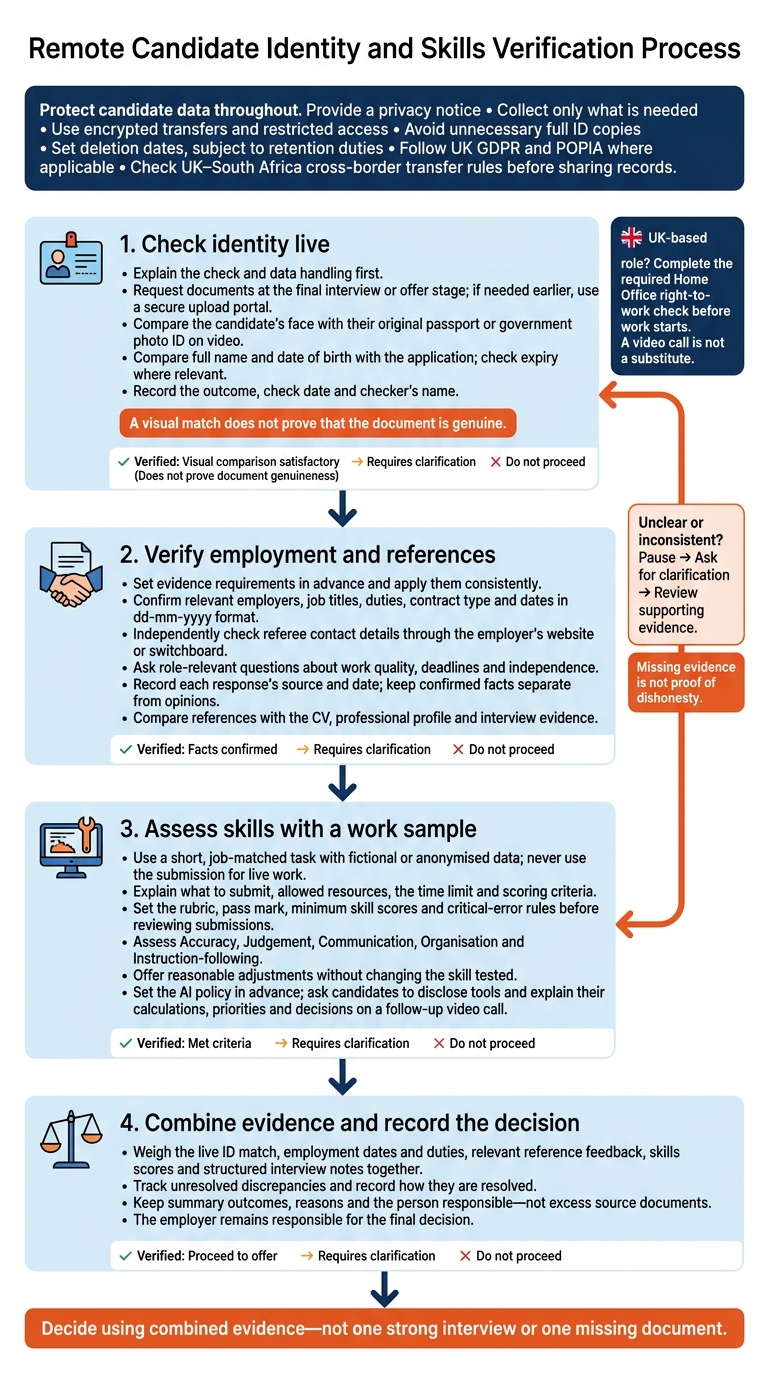
Remote Candidate Verification: Identity, References and Skills
Check Identity on a Live Video Call
Before the call, explain what you’ll check, why you need to check it and how you’ll handle the information. Request documents only at the final interview or offer stage. If you need them earlier, use a secure upload portal.
Match the Candidate to Their Photo ID
Ask the candidate to hold their original passport or government photo ID beside their face during the call. Compare their face with the photograph, and check the full name and date of birth against the application. Check the document’s expiry date where relevant. If the names differ, give the candidate time to explain and provide supporting documents.
A visual match does not prove that the document is genuine. It only shows that the person and photograph appear to match. If the image is unclear or the call quality is poor, pause and ask for clarification. Don’t treat poor image quality as proof of fraud.
Keep UK Right-to-Work Checks Separate
If the role is UK-based, complete the required Home Office right-to-work check before work starts. Treat this as a separate compliance check: a video call is not a substitute.
Record the Identity Check and Next Steps
Use the checklist below to record the outcome, alongside the check date and the checker’s name. Here, verified means the visual comparison was satisfactory - not that the document is genuine.
| Evidence requested | What to compare | Result | Follow-up action |
|---|---|---|---|
| Original photo ID shown live | Face, photograph and full name | Verified / requires clarification / do not proceed | Record the reason for the outcome |
| Clearer view, if needed | Unreadable details and expiry date | Requires clarification | Arrange another check |
| Explanation of a name difference | Application name against ID and supporting documentation | Requires clarification | Review the explanation before deciding |
If anything is unclear or inconsistent, pause and ask for clarification rather than rejecting the candidate straight away. Once you’ve checked their identity, move to employment history and references.
sbb-itb-f12512f
Verify Employment History and References
Once you’ve checked identity, compare the CV with independent evidence. Check only experience relevant to the role. Set evidence requirements in advance, apply them consistently, and explain how you’ll check references before contacting referees.
Confirm Employers, Dates and Duties
Ask for employer names, job titles, main duties, contract type and dates in dd-mm-yyyy format. For each referee, request their name, role, business contact details and working relationship with the candidate, including how long they worked together. Check contact details through the employer’s website or switchboard rather than relying on those the candidate provides.
Ask Referees About Relevant Work
Start by confirming how the referee worked with the candidate. Then ask about work quality, deadlines, independence and reasons for leaving, where relevant. Keep questions tied to the role: which tools did the candidate use, what did they handle on their own, and how did they respond to unclear instructions or feedback?
Record the source and date of each response. Keep confirmed facts separate from opinions: an employment date is a fact; a referee’s view of reliability is an opinion. Assess references alongside the CV, interview answers and work samples.
Clarify Gaps and Conflicting Details
Compare references with the CV, professional profile, interview answers and work samples. Use a shared checklist to flag conflicting dates, overstated titles, employers you cannot verify and unclear referee relationships. Ask the candidate to explain any differences and provide supporting documents.
Allow for South African terminology and employment structures. Missing evidence is not proof of dishonesty. Record what remains unconfirmed and why it matters.
Use any unresolved points to shape the work sample.
Assess Skills With Work Samples
Use unresolved questions from the CV and references to shape a short work sample near the final hiring stage. Provide written instructions that explain what to submit, which resources are allowed, the time limit and how you’ll score the work. Use fictional or anonymised data to test how the candidate works, and never use their submission for live work.
Choose a Task That Matches the Job
Choose a job-matched task, such as a bookkeeping reconciliation, customer-support reply with ticket prioritisation, or diary-conflict scheduling exercise.
Keep the task close to everyday duties. Use GBP (£) for financial tasks, and make dates and time zones clear for scheduling exercises.
Offer reasonable adjustments, such as assistive technology or extra time, without changing the skill being tested. Otherwise, give every candidate the same brief and time limit. Explain whether they can ask clarification questions. If you answer one, share that clarification with every candidate.
Score Work Against Set Criteria
Set the scoring rubric before reviewing any submissions. Decide the pass mark, the minimum score for each required skill and any critical-error rules in advance. Use the same rubric for comparable candidates, and score what the work shows - not your general impression.
| Task requirement | Observable evidence | Decision |
|---|---|---|
| Accuracy | Correct calculations; errors identified | Meets threshold / review |
| Judgement | Priorities supported by clear reasons | Meets threshold / review |
| Communication | Clear explanation for the intended reader | Meets threshold / review |
| Organisation | Complete, usable and logically arranged work | Meets threshold / review |
| Instruction-following | Required format, scope and resources followed | Meets threshold / review |
Ask Candidates to Explain Their Work
Set the AI policy before the task, including whether AI tools are allowed. Ask candidates to disclose the tools and resources they used and explain how they checked the result.
Use a follow-up video call to discuss their calculations, priorities and decisions. If their explanation differs sharply from the submission, ask about the difference and compare the two. A large gap can indicate proxy help or assistance that wasn’t permitted.
Store the task, score and notes with the rest of the verification record.
Protect Candidate Data and Document the Decision
Once the checks are complete, record only what you need and store it securely.
Limit Data Collection and Store It Securely
Give candidates a privacy notice that explains what data you collect, why you need it, how you use it and how they can request access, correction or deletion. Follow UK GDPR and, where applicable, POPIA. Check cross-border transfer rules before sharing records between the UK and South Africa.
Use encrypted transfers and restrict access to stored identity, reference and skills-check records. Avoid keeping full ID copies or unrelated financial data. Store sensitive documents separately from general hiring notes, set deletion dates and securely delete records when they’re no longer needed, subject to applicable retention duties.
Explain data handling in the privacy notice, then record the check results in one verification record.
Complete the Candidate Verification Checklist
Keep one final decision record covering the live ID match, confirmed employment dates and duties, relevant reference feedback, skills scores and structured interview notes. In the final decision log, record only unresolved discrepancies and how they are resolved. Keep summary outcomes, not excess source documents.
Mark each check Verified, Requires clarification or Do not proceed. Record the reason and the person responsible. Track outstanding items before making a hiring decision, and complete applicable checks before work begins.
Conclusion: Use Multiple Checks to Decide
Weigh the identity check, references and work sample together, and give candidates a chance to explain inconsistencies. Base the hiring decision on the combined evidence, and keep the record secure and ready for audit. The employer remains responsible for the final decision.
FAQs
Do South Africa-based remote staff need UK right-to-work checks?
No. Staff based in South Africa who work remotely for a UK company do not need UK right-to-work checks. These checks confirm a person’s legal right to work in the UK. They do not apply to staff working in South Africa.
Employers must still follow South African employment laws, tax rules and payroll requirements. This often means setting up a local entity or using an employer of record service.
What if my candidate’s former employer won’t provide a reference?
A former employer’s refusal to provide a reference doesn’t automatically rule out a candidate, but it calls for further checks. Reluctance to share references or a work history that’s hard to verify may point to performance issues or fabricated claims.
Ask for other professional references, such as former colleagues, direct reports or clients. Use scenario-based interviews to discuss past responsibilities and failures. Then prioritise verified skills assessments based on actual work tasks, or a short, paid trial project, to assess what the candidate can do directly.
How long should I keep candidate verification records?
Keep candidate verification records only for as long as needed for a legitimate business or compliance purpose. Follow your company’s retention policy and applicable legal obligations.
Store identity checks, assessment results and decision logs securely, and handle them in line with privacy standards. Review your storage practices regularly to check they meet changing legal requirements and business needs.