International Hiring
How to Pay Overseas Contractors From a UK Business
Compare total GBP cost, meet UK tax and compliance rules, and confirm the net ZAR your overseas contractor actually receives.
7 min read

I’d compare the total GBP cost with the amount your contractor receives before choosing an overseas payment method - not just the transfer fee.
For a UK-to-South Africa payment, I’d compare international bank transfers, Wise Business and PayPal on fees, exchange rates, delivery time and access to ZAR. Then I’d:
- Agree the fee, currency, payment date and who covers charges.
- Verify identity and bank details, checking any changes through a separate, trusted channel.
- Check employment status, UK tax, VAT, sanctions and data-protection duties.
- Approve the invoice, allow for bank holidays, confirm the net amount received and keep the records together.
For example, if the contractor needs ZAR 23,000 and a fixed ZAR 230 receiving fee applies, I’d allow for ZAR 23,230 before conversion and other charges.
My rule: <u>check the amount that arrives, not just the amount sent.</u>
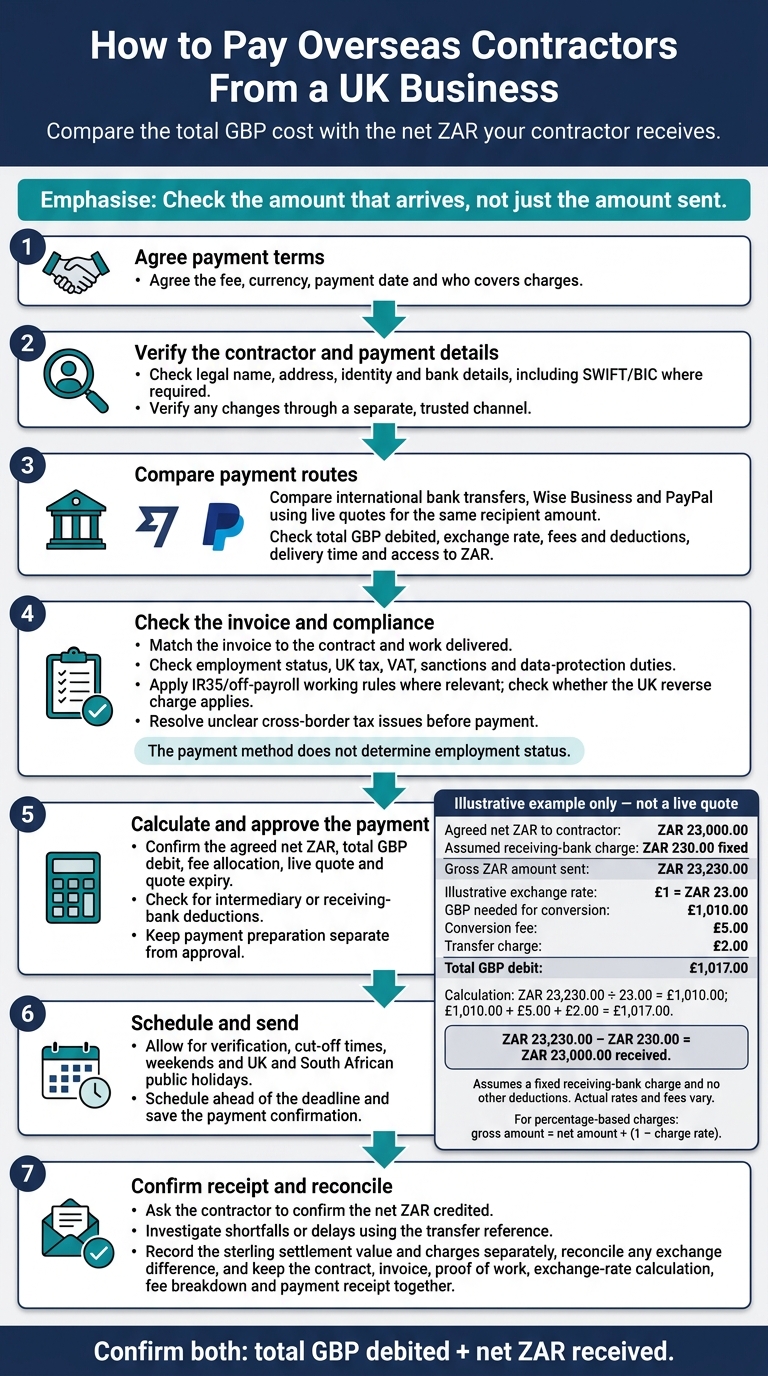
How to Pay Overseas Contractors From a UK Business
2. Compare international bank transfers, Wise Business and PayPal
For a UK-to-South Africa payment, compare the total GBP debited with the net ZAR the contractor receives. Request live quotes for the same recipient amount before approving payment.
Once you’ve chosen a payment route, match the transfer to the invoice and your records.
| Check | International bank transfer | Wise Business | PayPal |
|---|---|---|---|
| Total cost and deductions | Sender fee, plus possible intermediary and receiving-bank charges that reduce the net ZAR received | Quoted fee depends on currency, amount and funding method; usually no further deduction | Commercial payment fees, conversion costs and possible withdrawal charges can reduce usable ZAR funds |
| Exchange rate | Often includes an exchange-rate markup | Mid-market rate | Conversion rate generally includes a markup |
| Typical processing time* | Usually 1–5 business days | Minutes to 2 days on supported routes | Wallet credit can be near-instant; bank withdrawal takes extra time |
| Recipient access in South Africa | Payment into a local bank account | Payment into a local bank account on supported routes | PayPal wallet, followed by withdrawal to a bank account |
| Required details | SWIFT/BIC, account number and any required local routing details | Recipient bank details and any branch code required for the route | Recipient email for payment; bank account for withdrawal |
Timing is a guide, not a delivery promise. Funding, verification, cut-off times and public holidays can affect when funds become available.
International bank transfers: rates, fees and deductions
Ask the bank for its exchange rate, sender fee and charging options. SWIFT transfers can pass through intermediary banks, which may deduct charges.
Confirm the required SWIFT/BIC and local account details. Also check whether OUR - sender-paid charges - is available. Choosing OUR does not always guarantee that the contractor receives the exact amount.
Wise Business: supported routes and payment quotes
Check that Wise Business supports both the recipient’s bank account and the GBP-to-ZAR route. Before paying, review the mid-market conversion rate, quoted fee and estimated arrival time.
Fees depend on the currency, amount and funding method. Confirm the transfer limit and quote deadline before funding the payment. Using Wise does not remove your UK tax or compliance responsibilities.
PayPal: business-payment fees and withdrawals
Confirm that the contractor has a PayPal account and a bank account for withdrawals. PayPal fees, conversion charges and withdrawal charges can reduce the amount the contractor can use.
Keep the live quote, payment reference and expected arrival date with the invoice for the next step.
sbb-itb-f12512f
3. Check invoices, records and UK obligations
Once you’ve chosen a payment route, match the invoice to the payment and complete the compliance checks before sending funds.
Collect invoices and keep payment records
Ask for an invoice with the contractor’s legal name, address, invoice number, currency, amount, payment instructions and a clear description of the work delivered. Before approving it, check that it matches the agreed work and payment terms.
Keep the contract, invoice, proof of work, exchange-rate calculation, fee breakdown and payment receipt together. This gives you a clear audit trail.
Check employment status, VAT and cross-border tax
The payment method does not determine employment status. Assess the working relationship, including control, independence and integration. Apply UK employment-status, off-payroll, PAYE and National Insurance rules where relevant.
Check whether the UK reverse charge applies. The contractor handles South African tax and local VAT, but you still need to meet your UK duties.
Get cross-border tax advice if status, withholding, reporting or permanent-establishment risk is unclear. Once these checks are complete and any issues are resolved, match the payment to the invoice and send it.
Check sanctions and protect payment data
Screen the recipient against sanctions restrictions. Provide any identity or anti-money-laundering information your payment provider requests.
Protect personal and banking data under UK data-protection law, limit access to authorised staff and keep payment preparation separate from approval. Retain dated evidence of checks and approvals, but don’t collect more sensitive information than necessary.
4. Calculate and send a UK-to-South Africa payment
Calculate the GBP cost of the agreed ZAR amount
Once the invoice is approved, use your chosen payment route’s live quote to calculate the total GBP debit for the agreed ZAR amount.
Illustrative example only: the contractor must receive ZAR 23,000.00, and your business covers a fixed ZAR 230.00 receiving-bank charge. Add that charge before converting to GBP, then add the conversion and transfer fees.
Item Illustrative value Agreed net ZAR to contractor ZAR 23,000.00 Assumed receiving-bank charge ZAR 230.00 fixed Gross ZAR amount sent ZAR 23,230.00 Illustrative exchange rate £1 = ZAR 23.00 GBP needed for conversion £1,010.00 Conversion fee £5.00 Transfer charge £2.00 Total GBP debit £1,017.00 ZAR 23,230.00 ÷ 23.00 = £1,010.00, then add £5.00 and £2.00 for a total debit of £1,017.00. This assumes no other deductions.
For percentage-based charges, calculate the gross amount by dividing the net amount by 1 minus the charge rate.
Check the live quote and payment deadline
Record the invoice currency, how charges are split, the quote time and the estimated arrival time. Before approval, recheck the live quote and its expiry. Check whether intermediary or receiving-bank deductions could leave the contractor with less than agreed.
Allow time for verification, cut-off times, weekends and UK and South African public holidays. Schedule the payment ahead of the deadline rather than starting the transfer on the day it is due.
Confirm receipt and reconcile the payment
Match the invoice to the contract and approve the funded amount and charges. Then send the payment and save the confirmation.
Ask the contractor to confirm the net ZAR credited, not just that the payment arrived. If it is short or delayed, use the transfer reference to investigate with the provider and resolve any shortfall.
Record the sterling settlement value and charges separately, then reconcile any exchange difference to the invoice.
5. Conclusion: follow a payment checklist
Once you’ve confirmed the payment method and invoice, check the contractor’s legal name, address, bank details and SWIFT/BIC. Then confirm the total cost in GBP and the net amount received in ZAR.
Before releasing payment, recheck employment status, VAT, cross-border tax treatment and sanctions. Apply IR35/off-payroll working rules where relevant.
Allow time for approvals, verification and bank holidays. Keep the contract, approved invoice, payment confirmation and reconciliation together to complete the audit trail.
Include these checks in one payment checklist to use before every overseas transfer.
FAQs
Should I agree a fixed GBP or ZAR fee?
It depends on who carries the currency risk. A fixed GBP fee means the contractor’s ZAR payment changes with exchange rates. A fixed ZAR fee means your business’s GBP cost changes instead.
State the agreed currency in your written agreement. Make clear who pays conversion fees and intermediary bank charges so the contractor receives the expected amount.
Must I deduct UK tax from overseas contractor payments?
You generally do not deduct UK tax from payments to genuine independent contractors. They are usually responsible for their local taxes. Check their employment status against HMRC’s criteria, as getting it wrong can lead to tax and legal penalties.
If a contractor works through an intermediary but would otherwise be an employee, off-payroll working rules may require you to operate PAYE and deduct National Insurance.
How long should I keep overseas contractor payment records?
The provided sources do not state a fixed retention period. UK businesses must keep overseas contractor records accessible for internal reviews and possible external audits.
Store signed service agreements, tax documentation, invoices and proof of payment together in one system. This makes them easy to produce if the relevant authorities request them.